


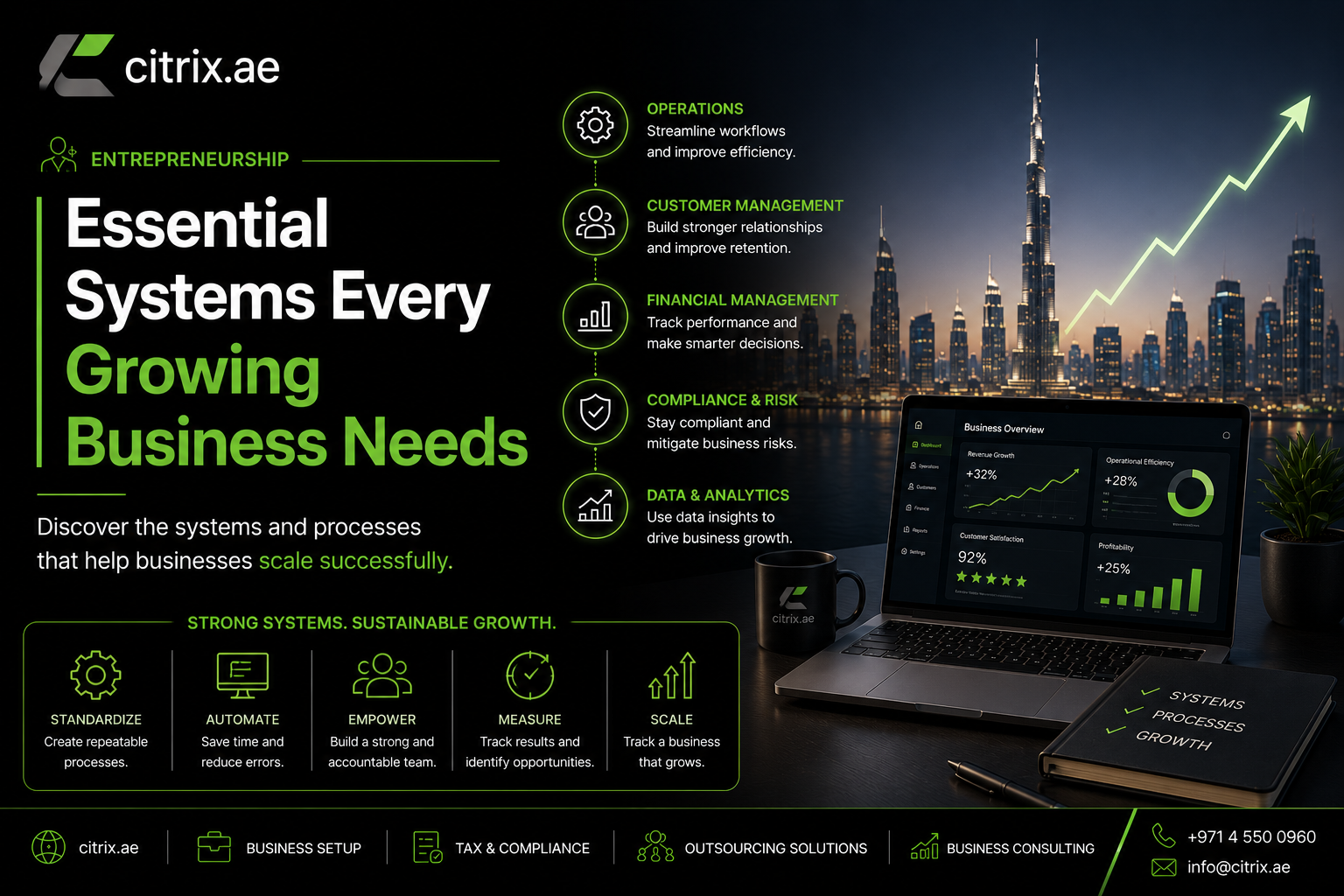
Discover the essential business systems and processes every growing company needs to improve efficiency, increase productivity, and scale successfully.
Essential Systems Every Growing Business Needs
Many businesses reach a point where growth begins to create new challenges. More customers, larger teams, increased workloads, and expanding operations can quickly overwhelm a company if the right systems are not in place.
While sales and marketing help generate growth, business systems are what make growth sustainable.
Successful companies rely on structured processes, automation, and efficient systems to maintain consistency, improve productivity, and scale effectively.
In this guide, we’ll explore the essential business systems every growing business needs and why they play a critical role in long-term success.
What Are Business Systems?
Business systems are structured processes, tools, and workflows that help organizations operate efficiently and consistently.
Instead of relying on individual employees to remember every task, businesses create repeatable systems that ensure operations run smoothly.
Business systems help organizations:
- Improve efficiency
- Reduce errors
- Save time
- Increase productivity
- Support scalability
- Enhance customer experiences
Companies that invest in systems often find it easier to grow without sacrificing quality or performance.
Why Systems Are Important for Business Growth
Many entrepreneurs initially manage operations manually.
However, as the business grows, this approach often becomes unsustainable.
Without proper systems, businesses may experience:
- Missed opportunities
- Operational bottlenecks
- Poor customer experiences
- Employee burnout
- Inconsistent service delivery
Strong systems create a foundation that allows businesses to expand while maintaining control and efficiency.
Customer Relationship Management (CRM) System
One of the most important systems for any growing business is a Customer Relationship Management (CRM) platform.
A CRM helps businesses organize and manage customer interactions throughout the sales cycle.
Benefits include:
- Centralized customer information
- Lead tracking
- Sales pipeline management
- Improved customer communication
- Better customer retention
A CRM ensures that no valuable customer opportunities are overlooked.
Financial Management System
Financial visibility is essential for sustainable growth.
A financial management system helps businesses monitor performance and make informed decisions.
Key functions include:
- Expense tracking
- Revenue monitoring
- Budget management
- Financial reporting
- Cash flow analysis
Businesses with strong financial systems are better equipped to plan for expansion and manage risks.
Accounting and Bookkeeping Processes
Accurate financial records support compliance, decision-making, and operational efficiency.
Effective accounting systems help businesses:
- Track transactions
- Prepare financial reports
- Manage invoices
- Monitor profitability
- Maintain regulatory compliance
Organized bookkeeping reduces financial uncertainty and improves business planning.
Human Resources Management System
As teams grow, managing employees becomes increasingly complex.
An HR system can help streamline:
- Recruitment
- Employee onboarding
- Payroll management
- Performance tracking
- Leave management
- Employee records
Strong HR processes contribute to workforce productivity and employee satisfaction.
Project Management System
Growing businesses often manage multiple projects, clients, and deadlines simultaneously.
Project management systems help teams:
- Assign tasks
- Track progress
- Manage deadlines
- Improve collaboration
- Monitor project performance
Well-organized projects lead to better client experiences and improved operational efficiency.
Sales Management System
A structured sales process helps businesses convert opportunities into revenue.
Sales systems often include:
- Lead generation tracking
- Prospect qualification
- Follow-up workflows
- Proposal management
- Performance reporting
Consistent sales processes improve conversion rates and support predictable business growth.
Marketing Automation System
Marketing plays a crucial role in generating leads and building brand awareness.
Marketing automation systems can streamline activities such as:
- Email campaigns
- Social media scheduling
- Lead nurturing
- Customer segmentation
- Performance tracking
Automation improves efficiency while helping businesses maintain consistent communication with prospects and customers.
Customer Support System
Excellent customer service contributes directly to customer retention and brand reputation.
Customer support systems help businesses:
- Track inquiries
- Manage support tickets
- Monitor response times
- Resolve issues efficiently
- Improve customer satisfaction
Providing exceptional service often leads to repeat business and positive referrals.
Document Management System
Growing businesses generate large amounts of documentation.
Without proper organization, important information can become difficult to locate.
Document management systems help businesses store and organize:
- Contracts
- Financial records
- Employee documents
- Client information
- Operational procedures
Centralized document management improves efficiency and reduces administrative challenges.
Business Process Documentation
Many businesses rely heavily on employee knowledge rather than documented processes.
This creates risk when team members leave or responsibilities change.
Process documentation should cover:
- Standard operating procedures (SOPs)
- Workflows
- Task instructions
- Compliance procedures
- Customer service guidelines
Documented processes improve consistency and simplify training.
Communication and Collaboration Systems
Effective communication is essential for business growth.
As organizations expand, communication challenges often increase.
Collaboration systems help teams:
- Share information
- Coordinate projects
- Conduct meetings
- Manage internal communication
- Support remote work
Strong communication improves teamwork and operational effectiveness.
Data Analytics and Reporting Systems
Business leaders need accurate information to make informed decisions.
Analytics systems provide valuable insights into:
- Sales performance
- Customer behavior
- Marketing effectiveness
- Financial results
- Operational efficiency
Data-driven organizations are often better positioned to identify opportunities and respond to challenges.
Cybersecurity and Data Protection Systems
Digital transformation has increased the importance of cybersecurity.
Businesses should implement systems that help protect:
- Customer information
- Financial records
- Operational data
- Digital assets
Important security measures include:
- Data backups
- Access controls
- Security monitoring
- Employee awareness training
- Cybersecurity policies
Protecting sensitive information helps maintain customer trust and business continuity.
Workflow Automation Systems
Automation reduces manual workloads and improves operational efficiency.
Businesses can automate tasks such as:
- Invoice processing
- Appointment scheduling
- Data entry
- Customer notifications
- Internal approvals
Automation allows teams to focus on higher-value activities while reducing the risk of human error.
Signs Your Business Needs Better Systems
You may need stronger business systems if:
- Employees frequently repeat mistakes
- Tasks are missed regularly
- Customers experience inconsistent service
- Leadership feels overwhelmed
- Growth is creating operational challenges
- Processes depend heavily on individual employees
Addressing these issues early can prevent future scalability problems.
How to Build Effective Business Systems
Start with Your Biggest Challenges
Identify areas causing inefficiencies or bottlenecks.
Document Processes
Create clear procedures for recurring tasks.
Invest in Technology
Use tools that support automation and efficiency.
Train Your Team
Ensure employees understand and follow established systems.
Continuously Improve
Review systems regularly and make adjustments as the business evolves.
The Role of Systems in Business Scaling
Businesses that scale successfully rarely rely on individual effort alone.
Instead, they build systems that allow operations to function consistently regardless of business size.
Strong systems create:
- Predictable outcomes
- Improved efficiency
- Better customer experiences
- Increased profitability
- Sustainable growth
The most successful companies view systems as strategic assets rather than administrative necessities.
Final Thoughts
Growth creates opportunities, but it also introduces complexity. Businesses that invest in strong systems and processes are better equipped to manage expansion, maintain quality, and achieve long-term success.
From CRM platforms and financial management tools to project management, automation, and customer support systems, the right infrastructure can transform how a company operates.
For entrepreneurs seeking sustainable growth, building effective business systems is one of the most valuable investments they can make.
